
Why Commission Based Display Remarketing is Cannibalising Your Direct Channel (‘Partners Not Partners’ Series)
Executive Summary (the short read)
What you need to know: The Display Remarketing Model is Fundamentally Flawed
Approach sold as a mirror of an Amazon-style quick-purchase funnel..
Model assumes a direct, linear path to booking, which misrepresents actual hotel guest behavior.
Partners add site visitors to remarketing lists and charge commissions for any resulting booking.
Reality Check: Complexity of the Hotel Booking Journey
Hotel bookings are multi-touch, often spanning multiple websites and information sources.
Typical journey: leaves website → OTAs (e.g., Booking.com) → hotel site → review/social sites (TripAdvisor, Instagram) → hotel site → booking (journey can be repeated up to 20 times prior to the final booking).
Multiple returns to the hotel website, each time triggering a remarketing list tag.
The Outcome: Over-payment & Cannibalization
Many direct bookings would occur without retargeting ads.
Commission structure results in hotels paying for bookings they likely would have gotten anyway.
Increases advertising commissions paid monthly, cannibalizing organic or direct traffic.
The Impact: Poor Advertising Quality
Remarketing ads shown are often of low quality and add little value.
Guests click on ads simply because it’s easier than typing in the hotel’s name or URL.
Ads mainly serve as a shortcut, not a true incentive, for website return.
Why Hotels Use It: Technically Difficult to Audit
Hotels often unaware they’re being charged for their own organic guests.
Technical details obscure actual performance and ROI of campaigns.
Partners may "gaslight" hotels about the true benefit and necessity of remarketing services.
The Actions to Take:
Many hotels using these services are being overcharged without understanding the impact.
Specialist advice is necessary to identify and eliminate unnecessary commission payments.
Download our checklist, so you can audit your Partner.
Get in touch so we can help your hotel get more direct Business.
The Context (read this if you missed our last post)
In our last post we made the case for your hotel’s success when going up against billion-dollar OTAs - their all-seeing eyes creating havoc for your rate managed universe.
We then provided some context showing how the OTA model is coming under threat, and how we reposition hotels within the unstable rate universe (We do this by focusing on the hotel’s unique features, and by laser targeting its core revenue markets). This was noted as being possible due to a unique technology stack we have matured over 16+ years, managed by humans.
It’s not given over to AI, it not about managing hotels inside a portfolio as a single group. Because of this we bring in the higher value bookings.
We also made the point that competitor services, that tell hotels how their solution will replace a hotel’s OTA business, was frankly pie in the sky. By contrast our own service goals were explained as follows:
We guarantee that we will deliver more direct bookings help you drive higher ADR year-on-year, and give your reservations teams more opportunities to upsell, because you own the customer earlier, not at check-in!
We mentioned that we were very closely aligned with the hotel pain points and provided a snapshot of the current rate market to show readers we understood how:
OTA Partners were taking official rates and sourcing leaked wholesale rates or eating into their commissions, just to hold price competitiveness.
The Outcome: The death of a hotel’s direct channel.
Then faced with a lack of control or leverage in the rate marketplace, it’s was no surprise that Revenue Managers felt helpless. We acknowledged that is was very difficult to read between the lines, when under this rate pressure, too see the market changes as an opportunity to win market share and direct bookings.
Our service challenges the following Revenue Management problem statements:
“We can’t compete with their reach” (true, but you can still win business)
“Book Direct” strategies are too hard to manage on a day-to-day basis” (not true, they just have not been defined correctly)
“It adds another layer of rate complexity to my job” (not, it works alongside OTAs channels, safeguards the hotels future and delivers bookings with lower acquisition costs).
In fact, the reality is that OTAs are on the ropes, that’s what the rate market is telling us.
If your hotel is heavily invested in OTAs and is ignoring direct channel growth, then all it takes is something seismic to happen at a local or international level, and your hotel is in the ring, on the ropes, chasing rates to the bottom of the barrel.
We remember how painful COVID was for our industry, but many of our hotels kept their doors open throughout because they had invested in our company, that supported them throughout the period, and defied the OTAs as their single source of income.
OTAs are always going to be undercutting your official rate, but with our services we can deliver a ton of revenue because they operate at scale and can’t t react to market changes as quickly as we can. Combine that with our hospitality expertise, amazing tracking and reporting technology, and through the close partnerships forged with Revenue Managers at hotels, revenue is the only outcome for your hotel.
Veribooking works tirelessly on room revenues - it not about engagement or likes, it is about driving revenues.
We said our our clients’ lift anchor and become speedboats, manoeuvring around a busy harbour, while OTAs and other partners struggled to change direction because of their size.
That was a summary of our last post, now let’s take a look at others that are infringing on your hotel’s hard-won business and brand.
The Longer Read
Context
In this post we want to highlight something that’s been developing post COVID.
It’s where we see hotel Partners muscling in on a hotel’s revenue in ways that some might consider even worse than OTAs - while OTAs occupy a love/hate/need relationship for a hotel, at least their role is defined and clear.
It's difficult to point the finger at any one type of partner because today’s hospitality marketplace has partners that have become one-stop-shops for all a hotel’s needs.
Take a booking engine, that once upon a time just did that job: they processed bookings and took payments. Now you can find that same partner taking bookings, building websites, offering CRMs and all the bells and whistles of a digital marketing service. Other partners might offer online representation or membership loyalty, while bolting on similar services.
For some hotels these type of services are not necessarily a bad thing, they can work just fine where in-house there is no capacity to manage them. The risk is always present though, once you go all in with a single-provider, it might be difficult to detach certain services, if they aren’t performing well.
Sometimes at Internet Affected, we feel like knights going into battle for hotels, just so we can launch a service that competes with one being provided by a partner. We help hotels question the partner and find that often there is gap between what the hotel believes is happening, and what is in fact happening via-a-vis their own direct channel.
Our primary focus has always been to help hotels more revenues from rooms, more while increasing ADR and increasing their market share (we call it’s digital footprint) by increased direct booking volumes.
Total volume of sales is a key metric because as any Revenue Manager will confirm, filling the hotel is easy, just drop the rates. But in the same breath, they will also tell you it attracts the wrong type of guest.
So, when a partner tells you that the best way to capture a booking is by dynamically lowering the rate, apart from it being the race to the bottom, you also attract the wrong type business. But if the goal is to earn a performance fee from that booking, rate is not the consideration, it’s about clocking fees.
Instead of this being a strategy, your hotel is targeted as a product enhancement.
Because of the problems singling out one specific type of partner, and because of the general interchangeability of services within a single partner, we’ve come to the conclusion that the best way to help hotels understand whether they are subscribed to services that might be working against their direct channel, is to simply describe them.
If your hotel is using them, you can then ask questions of whichever Partner is providing that service, and see what they say.
Stop display remarketing services from stealing your direct channel bookings
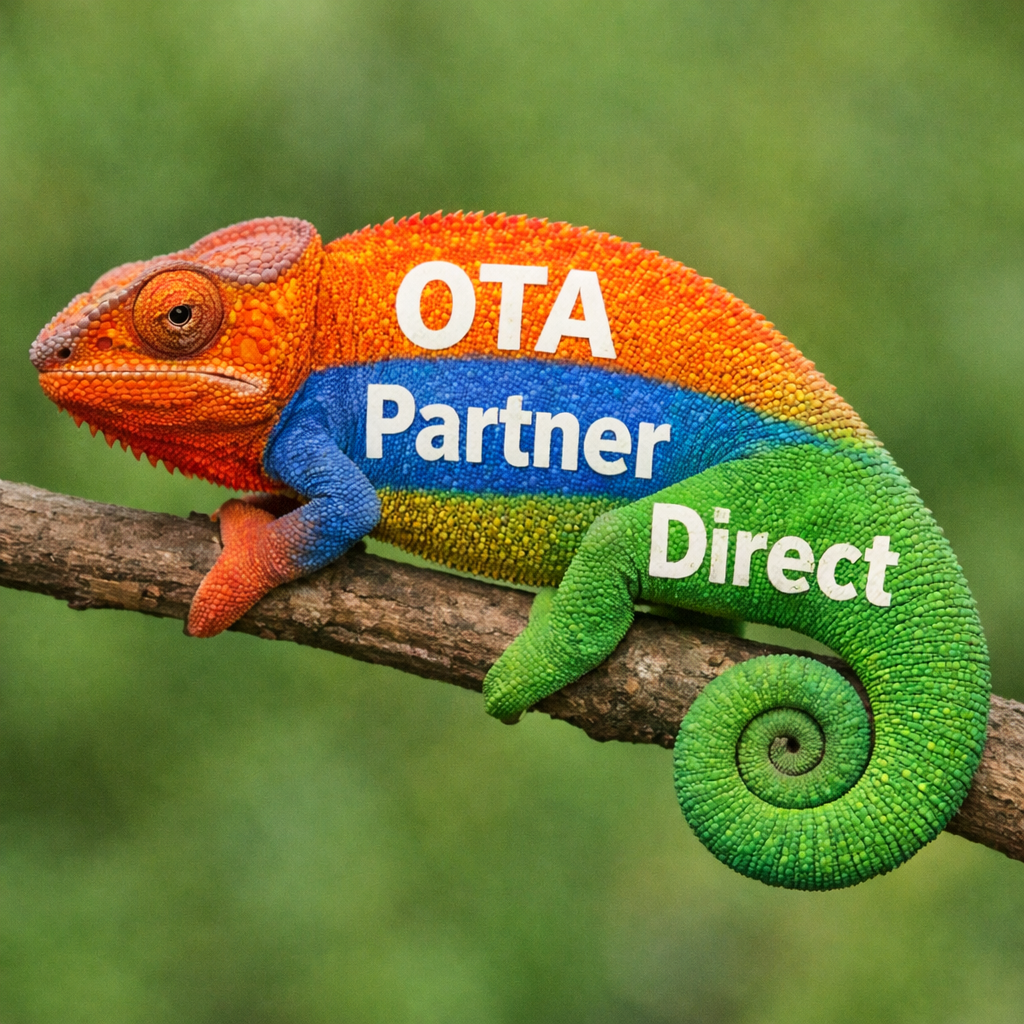
Booking a hotel is multi-visit (touch) journey, but some partners sell it to hotels as an Amazon style click-to-buy sales funnel as follows:
Booker leaves your hotel website → Booker sees an advert → Booker comes back → Booker Books direct → Partner charges the hotel a fee for that booking
And its sounds really logical and reasonable.
But it’s not how the hotel booking journey works at all.
Instead, the hotel booking journey looks like this (this journey has been simplified)
Booker arrives at your hotel website → Booker leaves your hotel website → Booker goes to an OTA to see what the hotel rate is, finds one and then looks at the room name for the rate → Booker comes back to the hotel website, then exits to the booking engine to check the OTA rate and room name against the hotel booking engine (OTAs often use different room names to make it harder for Bookers to compare rates) → Booker goes to a reviews website → Booker goes to Instagram to see videos and the visual experience of the hotel → Booker goes back to the hotel website and books.
Now, unless your team have been really savvy, what some partners do (and what you can discover for yourself by downloading our special report) is they tag each and every time your booker comes back to your website, so they can show an advertisement again after they leave.
Leading to the big question!
How many of those bookings would the hotel have won, if the adverts weren’t being shown at all?
We know the answer to that question: allot!
That’s because we can booking journeys in a way that is both respectful of a guests privacy (their consent is wrapped in), and without their activity getting bundled into sneaky remarketing lists that can used and re-used by partners that don’t make clear where its going to be aggregated, while it racks up performance fees.
In our special report, available free to all hoteliers, we’ll give you the exact strategy you need to follow to unearth whether these types of services are being fair to your hotel and guests, or simply treating both with contempt.
You’ll also be able to talk to your partner and drill-down with them on the value added they are bringing to your hotel, and whether it’s baloney or not.
We know that it might run contrary to the results you are seeing from these services, with performance fees rising each-month. But follow our approach and you might be surprised, and you’ll be able to see for yourself, whether the service is simply appropriating your direct business and selling it back to you with fees on top.
We’ll also share, using an equally logical but validated approach, how to be in a position to have the settings of these campaigns changed. Stand back and wait and watch what happens to the performance fees (they will drop, we bet your Direct channel will stay strong!).
We see hotels in the marketplace using these types of services, and when we look at the quality and messaging of the advertisements (we show you how you can see exactly the types of adverts your partner is running for your hotel), and contrast these advertisements with the revenues they are supposed to be delivering, the numbers simply don’t add up.
Arthur Conan Doyle wrote into Sherlock Holmes ,
Once you eliminate the impossible, whatever remains, no matter how improbable, must be the truth
We feel that some hotels are essentially paying for a service that does little more than provide a short-cut (the link in the advertisement) to get back to the hotel. In other words these campaigns are nothing more than a visual bookmark, positioned in channels where bookers go on their booking journey, sitting ready to capture click-attribution, rather than actually working for the hotel adding value and its enhancing its brand.
In our report we make recommendations for what good messaging looks like.
You will have heard of the services we cover, they’ll have made allot of sense, but your hotel will suffer when using them.
If you’re using them already, we know you have suspicions, because the results don’t align with your in-house systems, but you’ve got no-way to untangle it.
Display Remarketing is the first service we are examining under the microscope for hotels, and forms part of our ‘Partners not Partners’ series.
We’re looking to help hotels without the technical expertise in-house, to understand how some partners might be taking advantage of them. We will provide the steps to follow so you can push-back and take ownership of revenues that we feel are yours to keep.
We hope the report can help you protect your direct channel revenues, and help reset any partners scope that has been found to be lacking.
You can also get in touch with our team, and we’ll talk your through our unique services that are about growing your hotel business, caring for your guests and driving your room revenues. It is a unique service that provides unparalleled results and transparency in the hospitality marketplace, and we would love to show you the difference we can make to your property.

About the author
Glyn Spencer Hopkins is the owner of Internet Affected and has been working exclusively with hotels and luxury brands for over a decade.
Internet Affected provides digital revenue services tailored to the individual characters of hotels; a complete range of services designed to help them take back ownership of their hotel brand from the OTAs. Specialized marketing solutions to increase guest loyalty, food & beverage bookings, events and wedding inquiries, clearly reported in straightforward language.






How Performance Max quietly places hotels into each other's brand auctions - and why it goes unnoticed