
The only AI investment you control
Across hospitality, AI is being sold as inevitable: hyper‑personalised experiences, frictionless journeys, predictive operations, dynamic pricing, and a virtual concierge for every guest. The technology is real. The promise often isn’t—because it depends on an assumption that rarely holds in practice: that your hotel runs on a single, deeply integrated system.
Say the assumption out loud
Most hotels operate a fragmented stack: third‑party booking engines, CRMs and email platforms, restaurant reservations, meetings and events, payments, and a PMS—all from different vendors. Each holds a fragment of the guest. The prevailing AI story assumes that every vendor will share their fragment freely with a general intelligence layer.
They won’t. And not for technical reasons.
The system‑of‑record problem
This is an economic issue more than a technical one. Each vendor wants to be the system of record for its part of the journey because that confers recurring revenue, switching costs, data lock‑in and upsell. Full cooperation weakens their position. So cooperation remains limited to what contracts require.
AI is not integration
A language model cannot bridge systems that don’t expose APIs, expose partial APIs, charge for access, restrict sharing, or sit behind contractual and privacy limits. Integration is still integration—slow, expensive, and political. Adding AI on top of a fragmented stack does not defragment it.
Identity is the harder problem
Even where data flows, identity resolution is unresolved. Is John Smith in your PMS the same Jonathan Smith in your restaurant system? The same j.smith@gmail.com in CRM, the same corporate guest, the same loyalty ID? Without identity resolution, you don’t have a single guest profile—you have overlapping strangers. Customer Data Platforms invest heavily here and still struggle. A chatbot on your website will not solve it.
Compounding this, many hotels don’t fully control guest data. OTAs, booking engines, restaurant platforms, payment providers and loyalty schemes all work to own the primary relationship. The hotel—where the experience actually happens—often has the most fragmented view of its own guest.
What AI can usefully do today
Despite these constraints, AI can deliver real value when framed around what it can do despite a fragmented stack:
Contextual personalisation within systems. Each system gets smarter inside its own walls: the booking engine personalises the booking; CRM personalises email; the restaurant widget recommends the table. Not a single seamless journey—but better touchpoints.
Copilots, not autopilots. Let staff ask, “Summarise arriving guest Jane Smith,” and get back relevant, cross‑system highlights. No contracts threatened; no systems replaced. Swivel‑chair integration disappears.
Explanation, not black‑box optimisation. Pricing is already algorithmic. The value is in the why. Recommendations your team can interrogate, adjust and defend outperform opaque instructions.
Service recovery over prediction. Recognise when a guest has hit multiple issues and act before checkout. This lifts reviews more reliably than unproven anticipatory features—and doesn’t require a perfect profile.
Content acceleration, not autonomous marketing. Drafts, translations, localisation. The CRM stays the CRM; AI removes the blank page.
In short, AI should act as a conductor, not replace the orchestra. Hotels will not rip and replace their core platforms; new capability layers on top of existing investment.
The one promise you fully control: your website
There is one AI capability that does not depend on vendor cooperation: the new guest services layer—AI travel planners, virtual concierges, itinerary building, dietary‑aware recommendations, real‑time translation. Everything required to power this lives on the one platform you own end to end: your website.
Guests increasingly plan through conversational AI, not search boxes. They ask: Which hotels in Florence are within walking distance of the Uffizi and have EV charging? I’m travelling with two gluten‑free children; which property suits us? If your site buries answers in brochure copy, no AI can respond confidently. If your content is structured—with schema markup, consistent metadata and a robust content model—it can.
Apply the same to your venues. A restaurant page built as structured knowledge—cuisine, allergens, children’s options, accessibility, atmosphere, signature dishes—answers “vegan options and a quiet atmosphere?” anywhere that question is asked: your site, a search engine, or a third‑party travel assistant. Extend to local events, walking routes and things to do; serve it in any language; and planning becomes a conversation, not a research task.
The strategic shift
The chatbot is not the asset. Models are commoditising quickly. Two hotels can deploy the same model; the hotel with the richer, better‑governed, machine‑readable description of itself will deliver more accurate, useful, and persuasive answers every time. Competitive advantage moves from “who has the best AI” to “who has the best description of their hotel.”
Your website becomes the authoritative knowledge source for your property—the digital twin of the guest experience—feeding your concierge, search engines, external AI planners, voice assistants and staff copilots from the same structured content.
What to ask and where to invest now
Validate the data path. For any AI claim, ask which systems, which APIs, which data agreements—and get it in writing.
Budget for plumbing or shrink the ambition. If data cannot flow today, AI will not make it flow tomorrow.
Prioritise identity realism. Ask vendors how they reconcile identities across systems and what match rates they actually achieve.
Buy copilots before autopilots. Invest where AI helps staff summarise, prioritise and explain. It delivers value now and fails safely.
Demand explainability in pricing. Opaque recommendations are not governance‑ready.
Make the website your AI backbone. Invest in structured content, schema and a real knowledge model for rooms, restaurants, policies and destination content. It compounds.
How Internet Affected helps
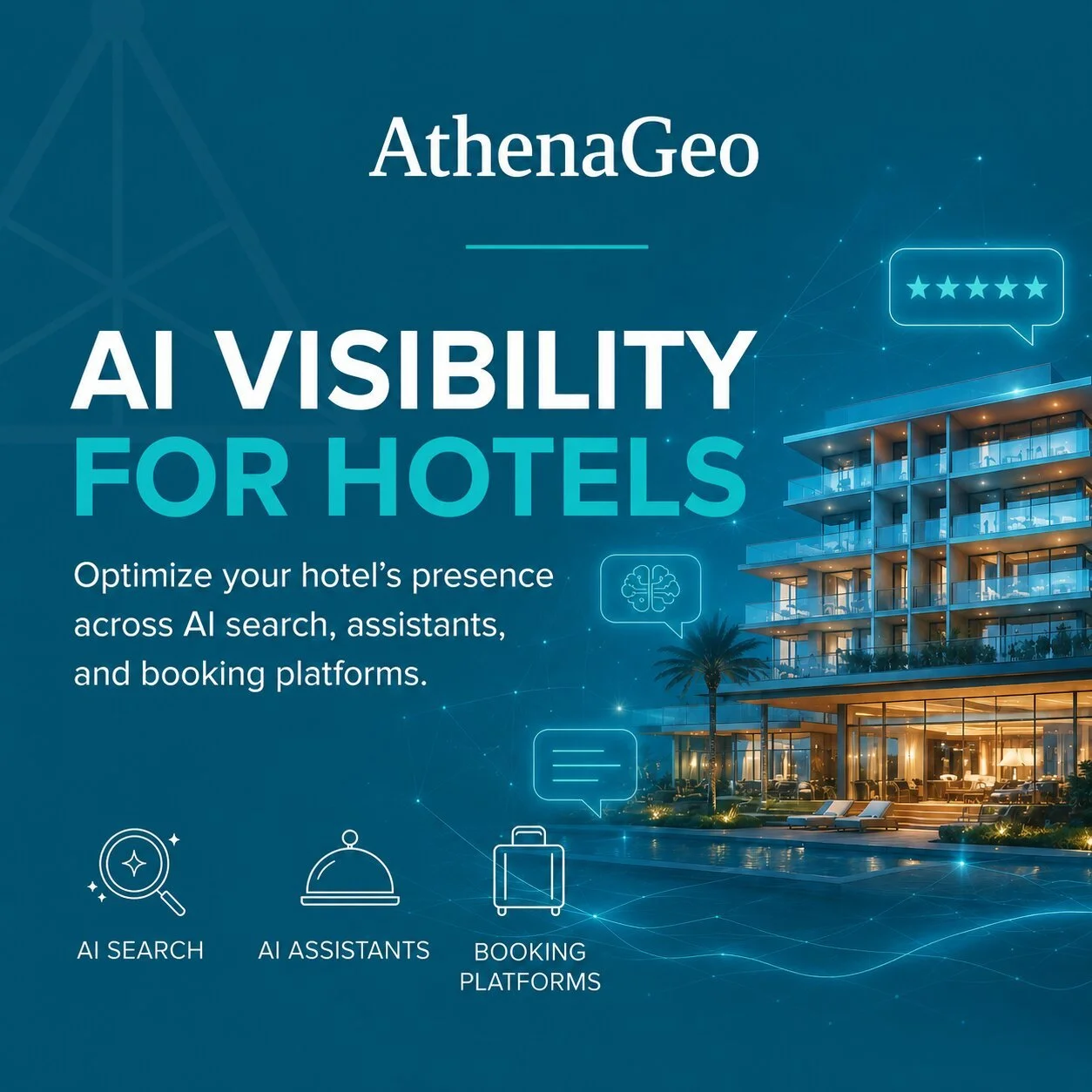
At Internet Affected, we built AthenaGeo to address the value left on the table by integration barriers. AthenaGeo enables hotels to create detailed, machine‑readable information profiles and publish them on their own websites so AI models can reliably index a property’s core DNA.
Restaurants become structured entities: opening times, dietary options, cuisine, atmosphere and accessibility—not a single paragraph of prose.
Meeting spaces are modelled as data instead of buried in PDFs: capacities,layouts, AV, ceiling heights, loading access, floorplans.
Room types receive explicit, exhaustive feature definitions — so if slippers, a panoramic view or a hairdryer is the deal‑breaker in a guest’s conversation with an AI agent, the agent can find the fact and answer with confidence.
The information switch has already happened. Booking platforms have proven that comprehensive, structured, on‑one‑page content drives conversion. Hotels can take control of that same advantage—on a platform they own.
If you would like to turn your website into the authoritative knowledge source for your property, Internet Affected can help you get there quickly and sustainably.
Get in touch and let us help your hotel.

About the author
Glyn Spencer Hopkins is the owner of Internet Affected and has been working exclusively with hotels and luxury brands for over a decade.
Internet Affected provides digital revenue services tailored to the individual characters of hotels; a complete range of services designed to help them take back ownership of their hotel brand from the OTAs. Specialized marketing solutions to increase guest loyalty, food & beverage bookings, events and wedding inquiries, clearly reported in straightforward language.









Blocking cookies no longer stops tracking, and scammers quote real bookings. This edition of Revenue Insights covers the questions every hotel should put to its booking engine and advertising partners.